

One of the biggest financial benefits of installing a commercial solar panel system is the 30% dollar-for-dollar tax credit that is a part of the Biden administration’s “Inflation Reduction Act.”
This tax credit is simple. If your business owes $300,000 in taxes to Uncle Sam for this tax year, and you buy a solar array that costs $1,000,000, you will receive a tax credit of $300,000 – and owe Uncle Sam nothing!
Check out our Warrick Rhode Island Project of the Year that received its own 30% tax credit!

Getting that big of a financial benefit for going solar almost feels like a bank error in your favor. However, it actually goes beyond that just a bit. There are bonus tax credits and state incentives, too, and when all these incentives are combined with accelerated depreciation – solar owners in the optimal tax situation can have a very fast payback!
The “bonus” tax credit of 10% means you get 10% of costs back when the installation company uses a certain amount of “Domestic Content,” or materials and equipment that are made in the US.For installations that start in 2026, 50% of all of the stuff used to build your system must be made in the US for you to get the 10% domestic content bonus tax credit. In 2027, that number goes up to 55%.
Incentives are expiring
Anybody who has taken a ride on the “solar coaster” knows politics play a big part in which federal incentives are available for renewables.Unfortunately, the current administration has made it a goal to cut solar tax credits and instead try to grow fossil energy sources – coal, oil, and gas.
As a result of the signing of the ‘One Big Beautiful Bill’, the tax credit for commercial solar is going away at the end of 2027. For a reality check, the residential tax credit went away at the end of 2025!
However, if your project begins construction before July 4th of this year, you have 4 years to complete it and still receive the tax credit.
This is going to be critical for utility scale solar and battery projects that take a while to build.
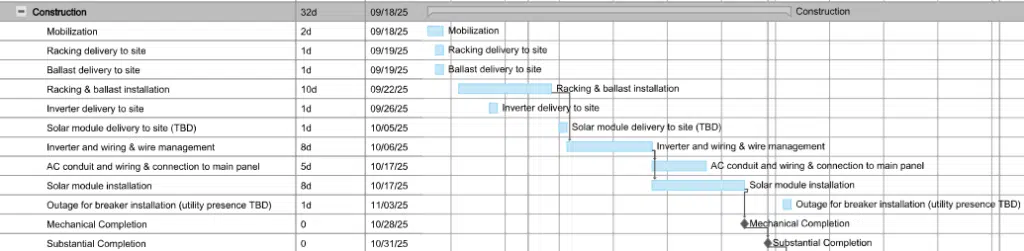
A typical commercial solar construction timeline can take over a month, after the permitting and interconnection process are done.
For commercial solar, projects move quicker. If you begin construction after July 4th 2026, you need to have your project turned on by December 31st, 2027 to receive the 30% Investment Tax Credit and domestic content bonus.
Commercial solar timelines
Commercial projects usually take about 1 year to complete, but this could easily turn into 2 years if there are structural issues or big power grid upgrades that need to be done before install. At CommercialSolarGuy, we believe if you want to build your solar project and get the tax credit, you should AT LEAST start the interconnection process with the utility as soon as possible.
For $5,000 to $10,000 – depending on size – we can get your project in line for interconnection — a critical step to ensure you have sufficient time to complete your project and receive the tax credit.
When claiming the full value of the ITC, solar projects in the US have a return on investment of 4-8 years. In states with higher rates of electricity and strong state incentives like the Rhode Island Renewable Energy Growth Program or the Massachusetts SMART Program the payback is around 4-6 years.
Projects that miss the upcoming deadlines to install solar will lose out on the Investment Tax Credit, and their project payback time will jump to 6-10 years.
While that’s still a respectable ROI, it is not ideal for most investors and the solar industry is going to have to respond with innovative planning to continue the growth of renewable energy in America.
If you’d like to know more about tax credits, and how to secure yours before they go away – reach out to Craig Sargent at 508-499-9786!