
Summary
Massachusetts has updated its SMART solar incentive program. In September 2026, the Department of Energy Resources (DOER) filed final revised SMART 3.0 regulations under 225 CMR 28.00. The latest changes clarify several rules around third-party-owned solar and Community Shared Solar (CSS), including customer savings, low-income participation, and disclosure requirements.
Whether you’re a business owner weighing a commercial rooftop or carport system, a municipality, or a residential customer comparing solar offers, here’s what changed, what didn’t, and what it means for your project.
Key takeaways
- SMART 3.0 remains Massachusetts’ primary solar incentive program. The September 2026 revisions are clarifications, not a new program.
- Pre-paid solar leases are now formally defined and must deliver benefits comparable to the 10% Third-party Owned Savings Requirement.
- Alternative Community Shared Solar programs, including municipal load aggregation and utility-run CSS, must allocate 100% of output to eligible Low Income Customers.
- For most commercial behind-the-meter projects, the direct impact is limited. The bigger commercial story is capacity: DOER’s draft Program Year 2027 report proposes 300 MWAC, down from 600 MWAC in 2026.
Here are the key changes worth knowing.
What changed for pre-paid solar leases under SMART 3.0?
A traditional solar lease typically involves monthly payments, while a pre-paid solar lease allows the customer to pay the lease cost upfront while a third party continues to own the solar system.
SMART 3.0 now specifically addresses pre-paid solar leases as part of its rules for residential third-party-owned systems. In response to public comment, DOER added a formal definition of a Pre-paid Solar Lease and said forthcoming changes to the SMART 3.0 Consumer Protection Guideline will explain how these offerings satisfy the Third-party Owned Savings Requirement.
For residential third-party-owned systems of 25 kW or less:
- Customers must receive a first-year savings benefit equivalent to at least 10% of the applicable Value of Energy.
- The rate charged to the customer for solar output cannot exceed the applicable utility rate during the same billing cycle.
- For a pre-paid solar lease, the project owner must provide documentation showing that the customer will receive comparable benefits to the 10% savings requirement over the term of the solar contract.
The important takeaway: SMART 3.0 does not create a separate incentive program for pre-paid leases. Instead, it clarifies how these arrangements can satisfy the existing customer savings requirements.
Community Shared Solar in Massachusetts, explained
Community Shared Solar allows multiple customers to benefit from a shared solar project without installing solar panels on their own property.
The solar project generates electricity, and the resulting value can be allocated to participating customers through electricity, energy cost savings, or Bill Credits, depending on the program structure.
For customers, the important question is not simply whether a project is called “Community Shared Solar,” but how the project is structured and how the customer receives the financial benefit.
SMART 3.0 timeline: key 2026 dates
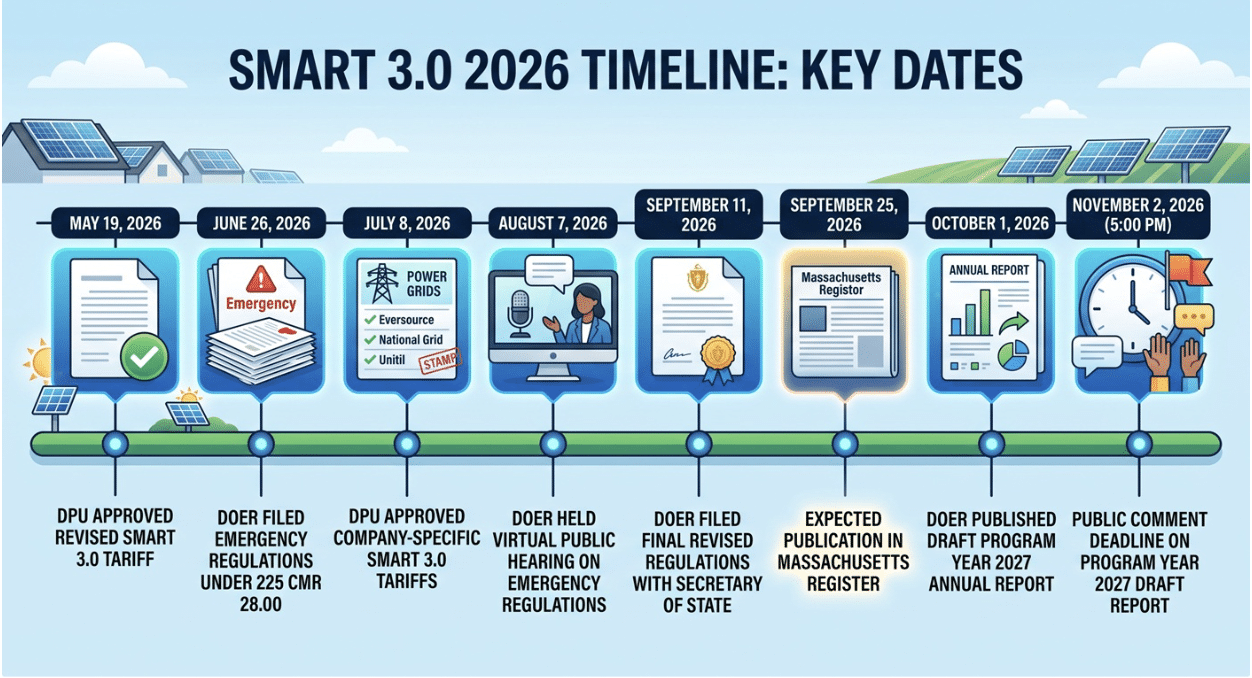
- May 19, 2026: The Department of Public Utilities (DPU) approved the revised SMART 3.0 Tariff.
- June 26, 2026: DOER filed emergency regulations under 225 CMR 28.00.
- July 8, 2026: DPU approved company-specific SMART 3.0 Tariffs for Eversource, National Grid, and Unitil, clearing DOER to begin issuing Final Statements of Qualification.
- August 7, 2026: DOER held a virtual public hearing on the emergency regulations.
- September 11, 2026: DOER filed final revised regulations with the Secretary of State.
- September 25, 2026: Expected publication in the Massachusetts Register.
- October 1, 2026: DOER published the Draft Program Year 2027 Annual Report.
- November 2, 2026 (5:00 PM): Public comment deadline on the Program Year 2027 draft report.
What’s new for Community Shared Solar under SMART 3.0?
SMART 3.0 includes specific requirements for Alternative Community Shared Solar Programs, including certain municipal load aggregation programs and Community Shared Solar programs established and administered by a Distribution Company. DOER describes these revisions as clarifications to the Guaranteed Discount Requirements for both program types.
For these programs:
- 100% of the generation output must be allocated to eligible Low Income Customers in the form of electricity, energy cost savings, or Bill Credits.
- Certain projects can satisfy the Guaranteed Discount Requirement through a calculation based on 30% of the average annual value of the applicable Alternative On-Bill Credit (AOBC) multiplied by the project’s total annual generation.
- Community Shared Solar projects generally must have at least 90% of their electricity, Bill Credits, or applicable energy cost savings assigned to valid and active utility accounts by the Incentive Payment Effective Date.
In simple terms, the rules address both who receives the benefit and how the required benefit is calculated.
SMART 3.0 customer disclosure requirements
SMART 3.0 also includes customer disclosure requirements for Community Shared Solar projects.
Customers generally need to complete a Customer Disclosure Form, which is submitted as part of the project’s Statement of Qualification application. The form is designed to document the customer’s participation and the terms of the arrangement. DOER publishes separate disclosure forms for direct ownership, third-party ownership, and Community Shared Solar on its SMART 3.0 Program Details page.
If a project adds new Customers of Record after receiving its Statement of Qualification, updated disclosure forms are generally required as well.
What SMART 3.0 means for commercial solar projects
The September 2026 revisions mostly affect residential third-party ownership and certain Community Shared Solar structures. For businesses, schools, farms, municipalities, and nonprofits building systems larger than 25 kW, the bigger questions are compensation rates, adders, and available capacity.
Program Year 2026 compensation rates
For Program Year 2026, SMART 3.0 Base Compensation Rates for systems larger than 25 kWAC range from $0.2807/kWh for systems over 25 kWAC up to 250 kWAC, down to $0.1790/kWh for systems over 1,000 kWAC up to 5,000 kWAC. Adders can raise compensation for qualifying projects, including building-mounted ($0.03), canopy ($0.08), dual-use agricultural ($0.09), public entity ($0.04), and Community Shared ($0.07).
Program Year 2027: less capacity proposed
Program Year 2026 offered 600 MWAC of capacity for projects subject to the capacity cap. DOER’s Draft Program Year 2027 Annual Report, published October 1, 2026, proposes 300 MWAC. DOER is accepting public comments on the draft until 5:00 PM on Monday, November 2, 2026.
If you’re planning a commercial rooftop, carport, ground-mount, or agrivoltaic project, the timing of your Statement of Qualification application matters. Learn more about our commercial solar construction services.
What this means in practice
For a solar customer, four questions are worth asking:
- Who owns the system?
- How will I receive the savings or Bill Credits?
- How much can I expect to save?
- What am I agreeing to in the contract?
For a typical commercial behind-the-meter project, these particular changes may have limited direct impact. For residential third-party ownership and certain Community Shared Solar structures, however, the details can matter significantly.
What is the Massachusetts SMART 3.0 program?
SMART 3.0 is Massachusetts’ solar incentive program, administered by the Department of Energy Resources (DOER). SMART stands for Solar Massachusetts Renewable Target, and SMART 3.0 succeeds the earlier SMART 1.0 and 2.0 programs under 225 CMR 20.00. The program provides incentives to eligible solar projects, with requirements that vary depending on project size, ownership structure, and program type.
DOER filed the latest revisions to the SMART 3.0 regulations on September 11, 2026, and the updated regulations were scheduled to publish in the Massachusetts Register on September 25, 2026. The changes include clarifications related to pre-paid solar leases and certain Community Shared Solar programs.
These final regulations follow emergency regulations DOER filed on June 26, 2026. DOER held a virtual public hearing on August 7, 2026, and received 15 sets of public comments before finalizing the changes.
SMART 3.0 FAQs
When did SMART 3.0 change in 2026?
DOER filed emergency regulations on June 26, 2026, then filed final revised regulations on September 11, 2026, with publication in the Massachusetts Register expected September 25, 2026.
Do the 2026 SMART 3.0 changes affect commercial solar incentives?
Not directly. The September 2026 revisions focus on pre-paid leases and certain Community Shared Solar programs. Commercial rates and capacity are set each year through DOER’s Annual Program Year Report, and the Program Year 2027 draft proposes 300 MWAC of capacity.
What is a pre-paid solar lease under SMART 3.0?
It’s a lease where the customer pays upfront while a third party owns the system. The project owner must document that the customer receives benefits comparable to the 10% first-year savings requirement over the contract term.
Have the SMART 3.0 tariffs been approved?
Yes. On July 8, 2026, the DPU approved company-specific SMART 3.0 Tariffs for Eversource, National Grid, and Unitil, allowing DOER to begin issuing Final Statements of Qualification.
Sources
For the most current requirements, see the Massachusetts DOER SMART 3.0 Program Details and the updated 225 CMR 28.00 SMART 3.0 regulations.
About Commercial Solar Guy: Commercial Solar Guy is a licensed commercial solar construction company based in New Bedford, Massachusetts. We build rooftop, ground-mount, carport, and agrivoltaic solar systems for businesses, schools, farms, municipalities, and nonprofits across Massachusetts and the Northeast. Questions about how SMART 3.0 may apply to your project? Contact Commercial Solar Guy.