
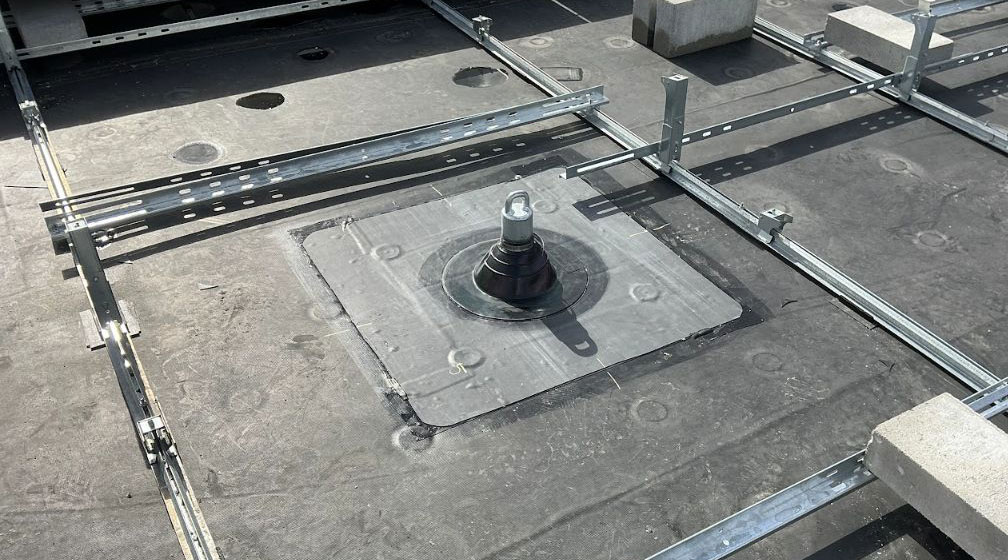
See that chunk of metal poking out of the black rubber boot? That there is a safety tie-off anchor, or more technically if we define its explicit purpose: a “fall arrestor.”
It’s basically saying **Stop! You are not allowed to fall! You are under arrest! It will upset EVERYONE!**
Seriously, nobody wants to see anybody suffer a preventable fall. It’s the worst possible thing that could happen on a job, so we take these precautions to heart.
We use these for jobs wherever we’ll have people working within 10 feet of the edge of a rooftop. It’s the law in both Massachusetts and Rhode Island, because both states have adopted the 2021 International Mechanical Code, which is where the requirement comes from.
Of course, one way to avoid using these is to not install solar panels within 10 feet of the roof edge, but this job called for every inch of space to be filled so the business could offset its electricity bills.
How the fall arrestors found their way into this job
When you’re planning a solar installation, you have to carefully plan where the panels and inverters will go so you can maintain the structural integrity of the rooftop. (Learn more in our step-by-step guide to commercial solar panel installation.)
Well, it just so happens the structural engineer who worked on this job had to cut down the available solar deployment area to a square representing 1/3rd of the structure’s available roof space, and just a 6-foot setback from the edge of the roof on one side..
That’s a tough limit to have, but we made the best of it.
With the new smaller roof area limit in place, CommercialSolarGuy’s own Benjie Borra got to work redesigning the layout of the 290 kWdc system and including five of these safety anchors — one for every 10 feet in the space near the edge of the roof.
How CommercialSolarGuy’s experience led to better results
Experience has taught us that it’s a better practice to get the anchors installed at the same time we lay down the solar racking. This allows us to fine-tune the placement of the racking around the fall arrestors.
The installation of the roof anchors requires multiple professionals. Amongst the first is a structural expert who saves human lives by knowing exactly where to place the anchor bases, and exactly which lag bolts are required for the unit to hold onto a falling human being. A second, is the person supplying attachments, and installing them – in this case it’s American Anchor’s Phil Ricci and their five Guardian CB-12 anchors. A third is a roofing expert who knows exactly how to preserve the integrity of the roof, or the “building envelope” as they say in the roofing business, and seals up the material on the roof. In this case, the roofer was a certified Carlisle roofing material expert whose work meets the manufacturer’s warranty requirements.
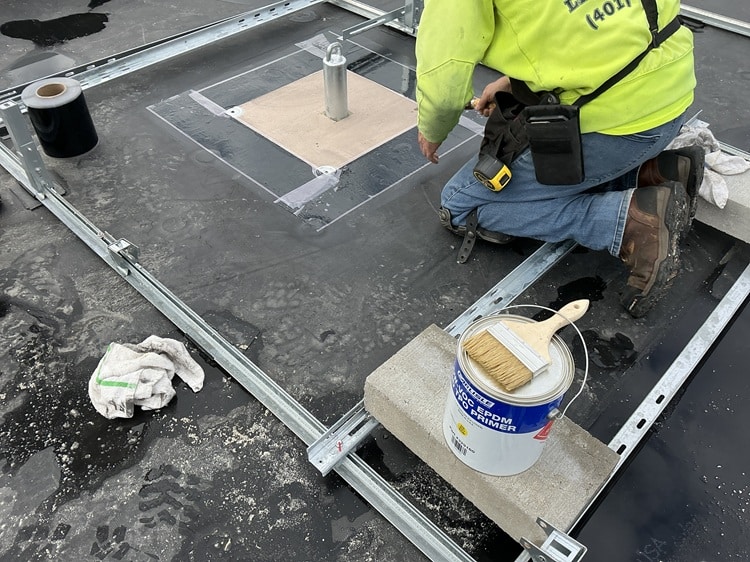
These anchor points will be installed for the lifetime of the roof, so several decades at least. The professionals that do this work offer a full warranty against leaks and other damage for the entire time period. These two folks work in concert, making sure the roof cuts are sharp, attaching the hardware to structure, then resealing the whole of the hardware beneath the black rubber material.
Wrapping it all up
This coordination of multiple teams while designs were evolving was an incredibly important part of bringing this solar installation to life. If we didn’t do it the right way, the first time, you can bet our internal walks, roofers, customer, or the city inspector would see it and send us back out to fix it!
Thank goodness the incredible Benjamín Borra understood just how important it was to get this right.
If you’re ready for our expert team to bring your commercial solar project to life, contact us here.