Net metering is often described as a “virtual battery,” because instead of storing excess solar energy in a physical battery, your solar power system “charges” the grid and receives credits in return. These credits then offset your power costs when the sun isn’t shining. Thanks to Rhode Island’s favorable net metering laws and relatively high electricity prices, the Ocean State is one of the best places in the nation to install solar.
Rhode Island’s Net Metering Program
Net metering laws in Rhode Island are among the most financially robust in the country. Rhode Island assigns net metering rates based on the following rate classes:
- Basic Residential (A-16)
- Low Income (A-60)
- Small Commercial (C-06)
- General Commercial (G-02)
- Large Demand (G-32)
Customers who use less electricity typically pay higher per-kilowatt-hour (kWh) rates but face lower “demand charges.” As a result, under Rhode Island net metering, these customers often receive higher credit rates for the solar electricity they produce.

Renewable Net Metering Credit
The Renewable Net Metering Credit applies to production up to 100% of the Renewable Self-generator’s usage during the billing period. The value is determined by the total kWh of electricity generated and consumed on-site, multiplied by the sum of:
1. Standard Offer Service kWh charge for the customer’s rate class
2. Distribution kWh charge
3. Transmission kWh charge
4. Transition kWh charge
In simpler terms, you receive a near 1:1 match for the electricity you produce versus what you consume—this is your Renewable Net Metering Credit. Even if your usage is fully offset, some taxes and fees may still appear on your utility account.
Excess Renewable Net Metering Credit
Any solar production beyond your on-site usage—up to 125% of your historical average consumption—earns a lower-rate Excess Renewable Net Metering Credit. These credits are calculated at the utility’s avoided cost rate, reflecting a discount from the standard net metering rate to discourage intentionally oversized systems. If a site spans multiple rate classes, the credit may use the average Standard Offer Service rate across those classes.
Below is an example of rates per class, with the Renewable Net Metering Credit rate in red and the Excess Renewable Net Metering Credit in blue:

Virtual Net Metering in Rhode Island
Another key incentive that drives solar adoption is Virtual Net Metering. Sometimes thought of as an extension of the “virtual battery” concept, Virtual Net Metering allows state agencies, municipalities, public and private schools, non-profits, and other eligible entities to apply net metering credits from one site to offset usage at another. To qualify, sites must either:
• Be part of a contiguous campus, complex, or farm, or
• Be owned or operated on behalf of a municipality or multi-municipal collaborative through a municipal net metering financing arrangement.
Opportunities for Ground-Mounted Solar
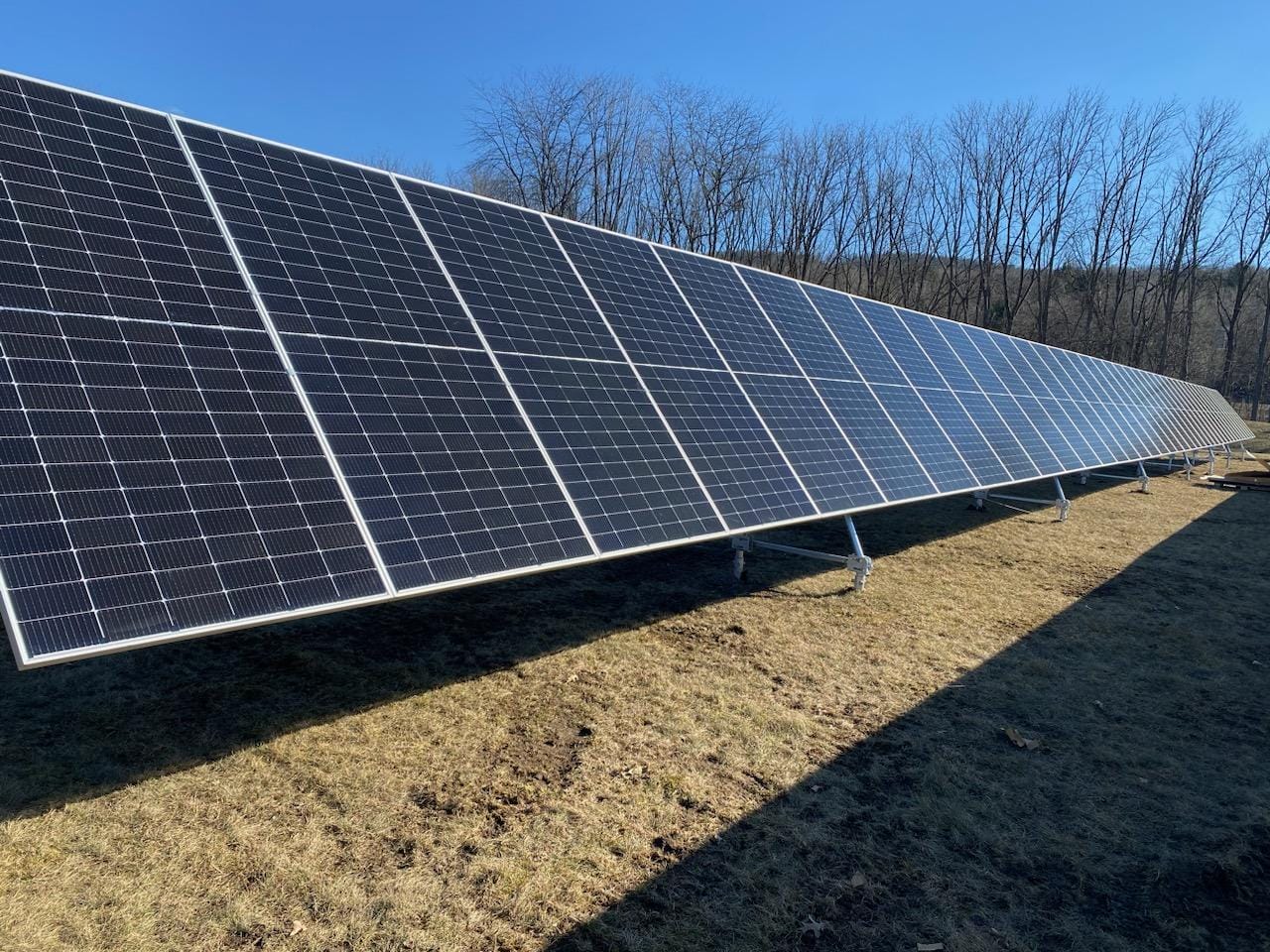
Rhode Island still has abundant capacity available for ground-mounted solar projects. In fact, the state has used less than 7% of its total allocated capacity for such installations—enough remaining capacity to cover Gillette Field approximately 1,500 times.
Considering the Renewable Energy Growth (REG) Program
While net metering is excellent for matching your electricity usage, it might not fully address all of a business owner’s needs. For instance, if your electricity bill is relatively small yet you have ample roof space, you could build a second solar project and participate in Rhode Island’s REG Program. This program offers a 20-year contract to purchase all the electricity your solar system produces, no matter how much electricity you consume onsite.
If investing in a project this large seems like too much to take on, CommercialSolarGuy can also install, maintain, and own the system at no cost to you. We will pay you just to use your roof! For more details, check out our Q&A on Rhode Island Rooftop Solar Lease Rates. For more in-depth coverage of the REG program, please read our article “Solar Companies in Rhode Island: Maximizing ROI with Commercial Solar Investments.”
In addition to net metering, Rhode Island offers other lucrative solar incentives. For commercial property owners, Rhode Island’s Commercial Solar Power Incentives program provides a 20-year guaranteed contract for selling electricity back to the grid, making solar a long-term, stable investment.
Are you considering leasing or purchasing a solar installation? Contact us today! Our team will provide a detailed assessment, break down the key differences between leasing and purchasing, and help you explore the best options for upgrading your roof to support a reliable, high-efficiency solar power system.