
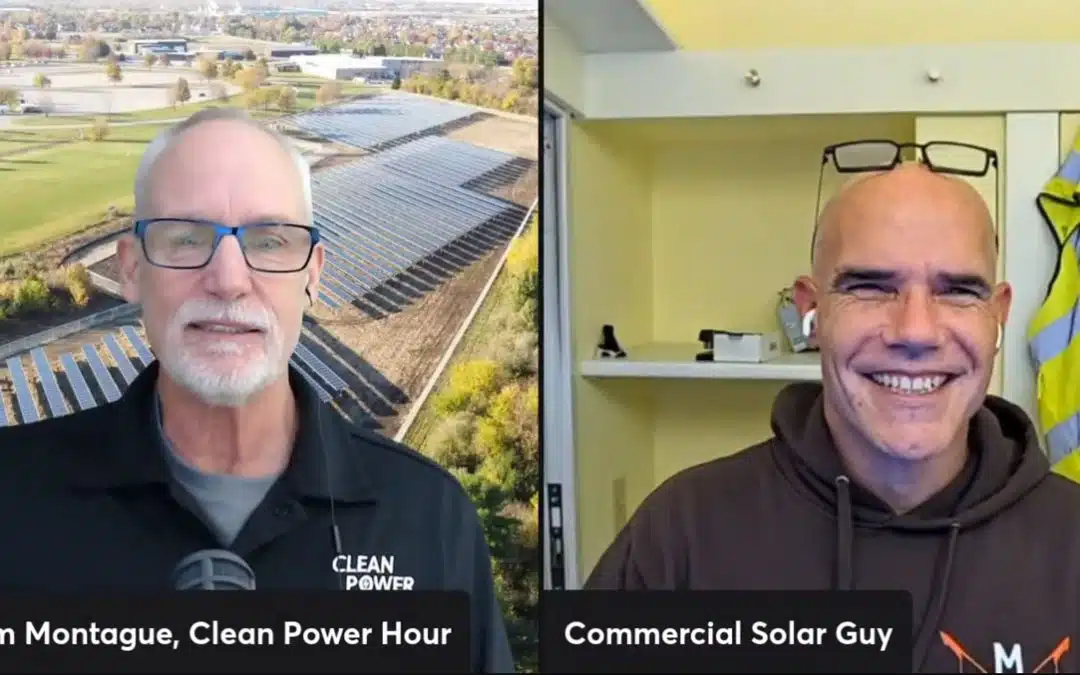
In the latest episode of the Clean Power Hour Live, hosts Tim Montague and John Weaver (the CommercialSolarGuy) dove into a mix of baffling policy maneuvers, massive manufacturing announcements, the technical standard defining the future of micro-scale distributed generation, and the roots of the solar industry.
Here is a look at key themes that drove the discussion:
- Policy whiplash: A proposed moratorium on solar in Missouri versus the restart of Vineyard Wind.
- The year of the big cell: Evolutions in battery form factors and chemistry.
- Micro-renewable innovation: The rapid rise of balcony solar legislation and UL standards.
- Manufacturing machismo: Elon Musk’s 100 GW solar manufacturing ”goal.”
Policy headwinds and tailwinds
The sharpest contrast in this episode was the disparity between policy progress in the Northeast and legislative roadblocks in the Midwest.
Montague and Weaver discussed a baffling development in Missouri, where a state senator has filed legislation proposing a moratorium on all new and existing solar construction through 2027. Weaver noted that while the ban targets a specific 430 MW project intended to double the state’s capacity, the language is broad enough to potentially halt projects currently under construction, inviting “considerable potential liability to the state”.
“It creates local jobs, it’s good for tax revenue, and it cleans the air,” Montague argued, questioning the logic behind stifling an industry that offers land-lease income triples that of traditional farming. Weaver said he has called on legal experts to weigh in on whether a state can retroactively stop permitted projects.
Meanwhile, on the East Coast, the industry saw a victory for offshore wind. Weaver highlighted the restart of the Vineyard Wind project, which had been halted by the previous administration. With a court overruling the stoppage, the project—a $4 billion investment—is back on track, with the final turbine recently heading out to sea.
Balcony solar goes mainstream
Distributed generation is getting even more distributed. Weaver reported on a surge in “balcony solar” legislation, with 25 states now considering bills to allow plug-in solar kits.
The hosts discussed Weaver’s recent pv magazine article on UL 3700, the new safety standard for these devices. Many of the laws in this legislative push require balcony solar systems to obtain UL certification before they can be sold to consumers, and UL 3700 was designed to address the need for such certification.
The standard addresses unique risks, such as whether ordinary 110V wall plugs and circuits can safely handle back-fed power without tripping breakers or causing “touch safety” issues. Weaver noted that UL’s approach is technology-agnostic: “We don’t really care what solution wins. We just want it to be safe”.
Market movers: Musk’s 100 GW and global investment
In a headline-grabbing segment, the pair discussed Elon Musk’s recent comments at the World Economic Forum in Davos, Switzerland about his goal for SpaceX and xAI to deploy 100 GW of solar to power their data centers—and potentially manufacture the equipment themselves. Indeed, shortly after the announcement, Musk announced that SpaceX would acquire xAI, potentially bringing this goal one step closer to reality.
While Musk’s timelines are often fluid, the sheer scale of the proposal—surpassing the total manufacturing capacity of the entire U.S.—sent shockwaves through solar stocks. “We need a lot of solar here on Earth, and now we need a lot of solar in space,” Montague quipped, referencing the potential for space-based data centers.
This ambition aligns with broader global trends. The hosts reviewed a Bloomberg report that found global energy transition investment hit a record $2.3 trillion in 2025. However, the data highlighted a widening gap: while the U.S. market grew by 3.5%, the rest of the world surged ahead, largely driven by massive deployments in China.
And speaking of China, a surprising portion of the conversation circled around a report that the European solar market could experience huge increases in the cost of solar goods purchased from China. With material prices set to increase 20 to 30 percent as China’s solar export discounts are eliminated, Weaver relayed that he has seen figures that say 5 to 15 percent of global solar projects may be put on hold as these changes take effect.
The tech frontier: big cells and zinc chemistry
While the macro conversation focused on policy, the technical segments highlighted how the industry is pushing physical limits.
Weaver dubbed 2026 “the year of the big cell,” noting a shift in lithium-ion battery manufacturing from 314 amp-hour (Ah) cells to massive 1175 Ah formats. He pointed out that as manufacturers like Eve, Sunwoda, and Envision scale up cell size, the industry expects to see further price declines, potentially dropping below $50 per kWh at the cell level in China.
On the topic of chemistry, Weaver shared an update on his own active project: a 700 kW solar array that may end up paired with an EOS zinc battery system. The project, designed to capture clipped electricity from an oversized DC system, utilizes zinc trays rather than lithium, highlighting the diversity of storage solutions now reaching commercial viability.
The roots of solar: hippies, cash, and “distributed pharmaceutical manufacturing”
We closed out the show with a fun history lesson courtesy of the upcoming documentary Solar Roots, which is slated for release in the fall of 2026. The film tracks the industry back to the mid-70s, long before the era of gigawatt-scale utility projects or sleek financing packages.
Back then, the “R&D” department consisted of folks living deep in the woods, rigging up lights to car batteries and driving their vehicles in circles just to recharge them. Weaver shared a classic anecdote about executives from Arco — the first major solar manufacturer — trekking out to the middle of nowhere to figure out who was buying their product, only to find “shoeless hippies” ready to pay for panels with straight cash.
As Weaver cheekily pointed out, the solar industry might actually owe its life to “distributed pharmaceutical manufacturing”. It turns out that a certain agricultural sector — one that highly valued off-grid privacy and the electricity to run grow lights — was effectively funding the early solar market long before the Investment Tax Credit was even a twinkle in Congress’s eye.
Connect and learn more
The solar industry moves fast. To keep up with John Weaver’s latest projects and policy analysis, connect with him on LinkedIn or catch him in person this week at RE+ Northeast in Boston.
For the full breakdown of these stories, including a look at the hippie roots of the solar industry in the upcoming documentary Solar Roots, check out the full episode of the Clean Power Hour.