
The December 9th, 2025 episode of the Clean Power Hour saw cohosts Tim Montague and John Fitzgerald Weaver speed run through a list of important news stories from the previous two weeks.
The two covered a broad range of topics from the clean energy industry, including the Illinois Clean and Reliable Grid Affordability Act, how America is crushing its storage goals (even as the world faces a shortage of some cell sizes), solar tariff exemptions, international solar news, and domestic lithium and natural gas mining.
Here’s a rundown of the most important points in the conversation:
Commercial Solar Guy in Illinois
The conversation kicked off with an update on John Fitzgerald Weaver’s work. CommercialSolarGuy is expanding business into Illinois! This expansion is driven by new state legislation, known as the Clean Reliable Grid Act or CRG, which people in the state are pronouncing like “Surge.” Really rolls off the tongue, doesn’t it?
This bill, which the cohosts first covered in a previous discussion, is basically a response to the “One Big Beautiful Bill Act” that will supercharge the Illinois solar and storage market. John covered the bill in an article for PV Magazine, in which he discussed how the bill expands the Illinois Shines Adjustable Block Program and contains other policies to expand solar and wind capacity in the state.
Weaver is excited to begin working in the state because he’s able to access certain incentives reserved for EECs (Equity-Eligible Contractors), a status he qualifies for due to being a former ward of the state of Florida. The EEC incentives will help bring hundreds of megawatts of new community solar online in Illinois!
America Crushes Energy Storage Goals
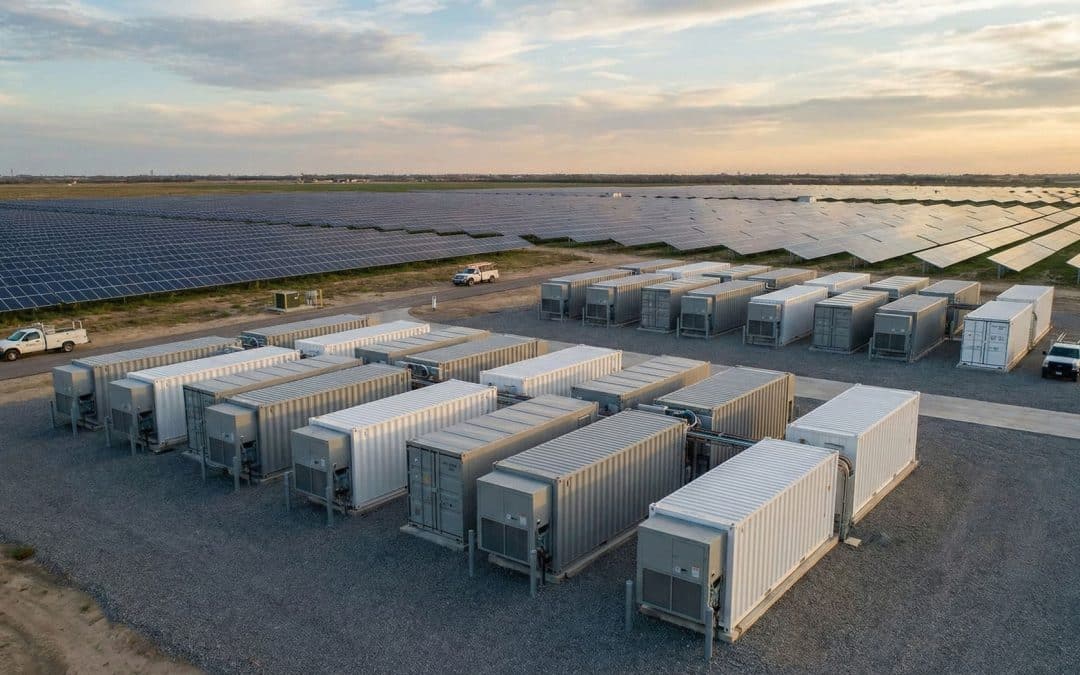
The conversation then moved on to a story by Julian Spector in Canary Media. The hosts discussed how the US grid storage industry achieved 40 gigawatts (GW) of storage in Q3 of 2025, surpassing an aggressive goal first envisioned back in 2017 by the Energy Storage Association.
John Weaver attributes this growth to the upward accelerating “S-curve of storage,” noting that the biggest surprise has been the cost decreases accelerating in recent years. A core concept in the discussion was the “flywheel” effect—the idea that solar and storage development work together and reinforce each other, leading to continued growth in both markets.
The hosts provided some evidence of the flywheel effect at work:
- An observation from Australia where battery incentives lead to customers adding small, complementary solar projects (e.g., 3 KW) to their battery, creating a new class of “battery led solar project.
- An installer in Tennessee that is attaching batteries to 100% of their solar projects for the added “peace of mind..
- The new Illinois legislation, which allows for front-of-the-meter storage (like 5 MW batteries) affiliated with community solar projects.
Battery cell shortages are a good thing?
This massive increase in utility-scale demand for battery storage is creating some interesting ripples in the market, as highlighted in the ESS News story, Battery shortage intensifies as 100 amp hour cells sell out into 2026.” The story describes how the market shortage in 100 Ah cells (which are often used in residential energy storage systems) is caused partly by the manufacturers focusing on larger-sized cells, 300 Ah and up.
Large manufacturers have shifted their focus to making grid-scale batteries and the shift is causing a sold-out market for the smaller cells needed for residential and smaller commercial projects. Weaver argues that this is a good thing, saying it signals a massive demand growth across the entire battery spectrum.
Global Solar and Trade Policy
The conversation also turned to international markets and US trade policy:
- US Solar Manufacturing Tariffs: The hosts discussed an article by Weaver about extensions of certain solar manufacturing tariff exclusions. The U.S. trade representative has extended Biden-era tariff exclusions for certain Chinese hardware needed to manufacture solar cells domestically (like silicon growth furnaces). This extension recognizes that some equipment is not globally available and gives US manufacturers time to build out the domestic supply chain.
- India’s Solar Surge: India is forecast to add 41.5 GW of new solar in fiscal 2026, and is projected to surpass the US in both annual deployment volume and total installed capacity in the coming years. Furthermore, India is using incentives to push higher-efficiency modules, similar to China’s Top Runner program. This initiative forces manufacturers to upgrade their technology, leading to more globally competitive products and a lower Levelized Cost of Electricity (LCOE).
EV and Energy Market Headlines
The hosts finished by covering a few quick hits on the energy and electric vehicle (EV) markets:
- EV 12V Battery: Weaver shared an anecdote about accidentally killing the 12-volt lead acid battery in his EV by running the heat without engaging the main battery, forcing him to jump the small battery to enable the large one. The 12-volt battery is primarily used to close the contactor that enables the high-voltage battery.
- EV Trucks in China: Electric vehicle adoption is “skyrocketing” in China, with all electric vehicles (including passenger, bus, and freight) approaching 50-60% of new sales. The growth in heavy-duty freight vehicles is significant, driven by the national interest in reducing imported oil and the lower lifetime ownership cost of EVs.
Lithium and Gas Prices: The US has significant lithium opportunities (e.g., in Nevada, Texas, and from fracking brine), and rising interest from political figures and oil majors indicates the industry’s economic potential. Additionally, US natural gas prices were noted as rising “massively,” attributed to seasonal cold, oil price fluctuations, and increased Liquefied Natural Gas (LNG) exports.