

A decade ago, it was tricky to predict the end-of-life plan for solar panels. After all, a typical solar panel can last 25-35 years, and forecasting that far into the future for a young industry is no small feat. Today, with more than 2 TW of solar installed worldwide, we have far better answers—and a robust market for solar panel recycling (and even the decommissioning of solar power plants) has emerged to meet growing demand.
And yet, misinformation persists. You may have heard these bogus claims before: “solar panels are toxic” or “solar panels leak toxic chemicals.” Let’s set the record straight: these are baseless rumors that distort the facts and defy logic. Research clearly demonstrates that solar panels are overwhelmingly safe, and new, certified solar panel recycling services are paving the way for an even more sustainable future.
Image: Whaling City Solar Installation

Debunking the “Solar Panels Are Toxic” Myth
One persistent myth is that solar panels are toxic and will contaminate the environment with harmful substances. But a quick look at the New York Solar Guidebook reveals that panels are mostly assembled from completely harmless materials. According to the guidebook:
“Solar panels largely consist of widely-used and non-toxic components, including an aluminum frame, tempered glass, and various common plastics. The most common type of solar panel consists of crystalline silicon PV cells which generate electricity when exposed to light. These non-toxic crystalline silicon cells consist almost entirely of silicon, one of the most common elements in the Earth’s crust.”
Silicon—the primary material most solar panels are made from—is one of the most abundant elements on Earth. The notion that solar installations will leak heavy metals all over your neighborhood is, frankly, ridiculous. So, why is anyone asking “are solar panels toxic” in the first place? Unfortunately, public perception and uncertainty surrounding this renewable energy source stem from extensive, coordinated disinformation campaigns funded by a fossil-fuel sector threatened by clean, cheap electricity.
Image – NREL
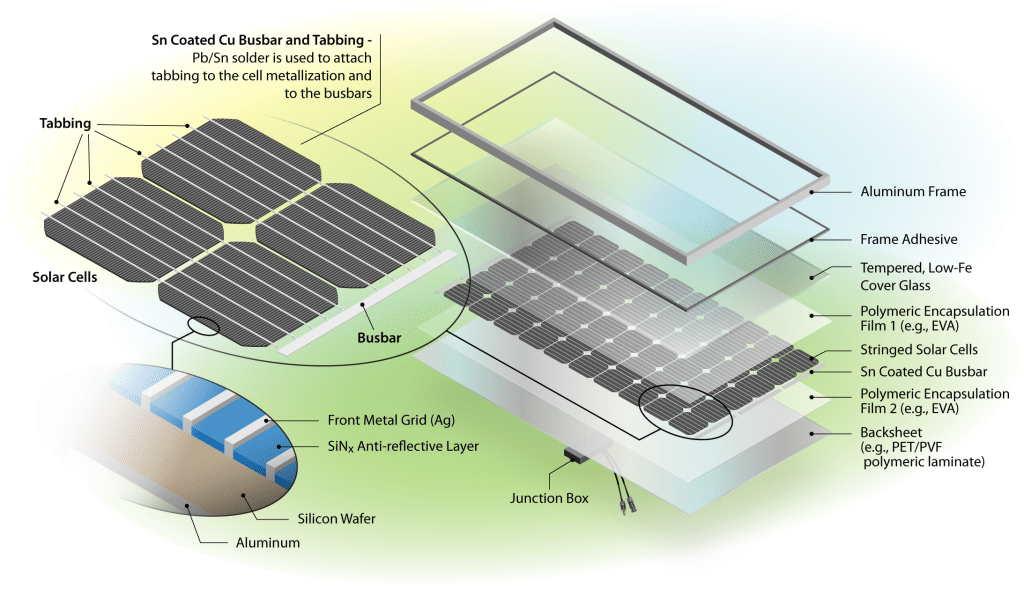
These disinformation campaigns take a grain of truth—yes, there are small amounts of toxic materials in solar panels—and then deliberately lie about the improbable chain of events required for those metals to leach into the soil. Virtually every modern electronic device uses some metals and chemicals, and solar modules are no different. However, these trace substances remain securely encapsulated within the panel’s layers, posing no significant risk under normal operating conditions.
Solar panels are designed to stay sealed off from the environment for decades. If a panel’s protective encapsulation is ever found to be compromised—through routine inspections or operations and maintenance—the affected panel is removed from service long before it could release any material.
When panels reach the end of their useful life, they’re increasingly handled by specialized solar panel recycling companies that recover nearly all of the materials for reuse.
A Look at Real Solar Panel Recycling Technology
One of the most exciting aspects of the industry’s growth is the rise of solar panel recycling companies capable of processing large volumes of old modules. For example, PV Circonomy in California has developed a “PV Circulator,” which disassembles solar panels step-by-step—from removing the junction box and frame to separating the glass from the silicon layers—all using air. By relying on air as its primary separation tool, 99.3% of each panel’s material is recovered, ready to be reintroduced into manufacturing for consumer products, construction materials, and industrial uses. That’s a far cry from the imaginary “toxic waste problem” you might see on certain dubious websites and insular social media groups.
Image – PV Circulator

Refurbish, Reuse, and Recycle
Recycling isn’t the only end-of-life option. Sometimes, older panels or entire solar arrays can be refurbished for second-hand use. Our own CPA at CommercialSolarGuy, Casey Gilley, also works with CSS Repower, a company that revives entire solar projects. Instead of disposing of functional equipment, they restore and redeploy older systems— extending the lifespan of solar assets and supporting the industry’s culture of reuse.
Another company, Ontility, buys and sells both new and used solar panels. For about $12 per panel, they can break even on refurbishing and reusing them. Older modules that can’t be refurbished are then recycled. Their services include decommissioning the modules, recertifying those that are still functional, and reselling them—all before resorting to recycling.

The Bottom Line: Solar Is Safe, Sustainable, and Getting Better
Far from being an environmental liability, solar panels are one of the cleanest energy options on the planet. And thanks to new technologies, well-established solar panel recycling services, and a growing interest in refurbishment, the industry is continually improving its sustainability—from production to retirement.
And as you’ve seen, the people still asking “are solar panels toxic” are simply repeating disinformation talking points from coal and oil barons. They take a grain of truth, ignore the science, and blow it wildly out of proportion to serve fossil fuel interests.
As the solar industry matures, recycling and repowering experts are playing a key role in keeping materials in circulation and systems in service. Because in the real world—unlike in certain misinformed corners of the Internet—sustainability and profitability go hand in hand.
If you’re planning a system upgrade, decommissioning, or looking for help with solar panel recycling, CommercialSolarGuy can connect you with trusted, experienced partners who get the job done right.
We’re ready to support your solar development—from engineering and procurement to construction. We specialize in commercial rooftops, parking lots, and ground mount systems up to 50 acres. Learn more about our team here or contact us today to discuss your project.
Or call us at 508-499-9786. We’d love to hear from you.